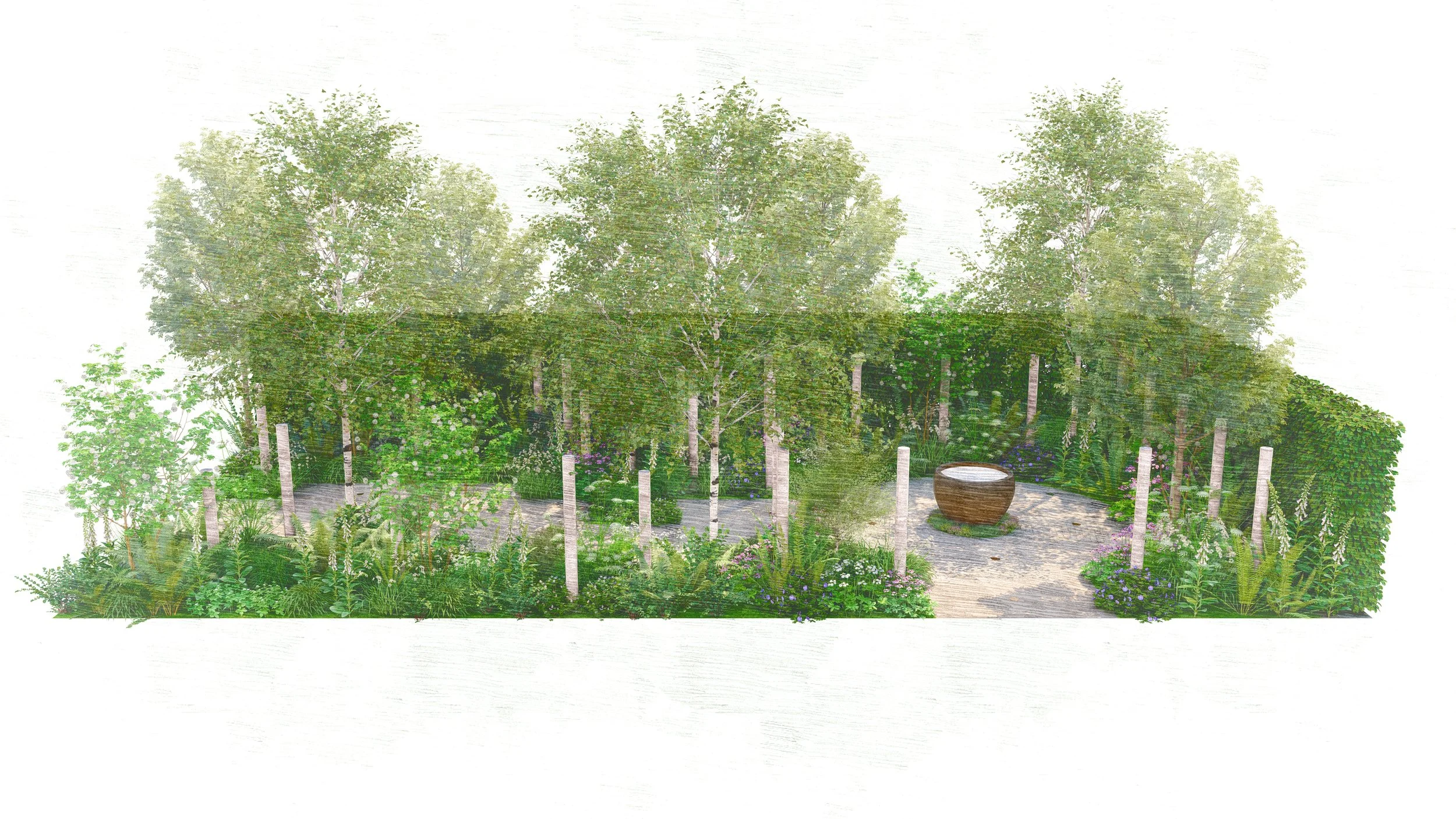
How to design an Award Winning RHS Show Garden
How do you design a garden that tells a story and aims to raise awareness for a national charity?
When I first sat down to design the Macmillan Cancer Support: The Nascent Shade Garden, this was the central question. Creating a beautiful show garden is one thing, but translating a vital, real-world mission into a physical landscape requires careful consideration. In this blog, I explore my process.
Start with the Brief
First, you identify the brief. Macmillan’s brief was to raise awareness about legacy gifts (gifts left in wills) and how they help support the vital work they do here in the UK for people facing cancer.
Before putting pen to paper, I wanted to understand Macmillan's key services and main mission, which is to make cancer care fairer in the UK by reducing the disparities that currently exist. Many people do not receive the care they need simply because of their background or where they live.
I knew immediately that I wanted to weave this mission into the garden, and that the garden would be stronger for it. This way, I would not just be highlighting the funding that comes from legacy gifts, but visually explaining why that funding is so deeply important.
Macmillan also wanted a walk-through space, so leaning into this, I set out to create a transitional space that shows a physical journey: moving from a place where there is disparity and inequality, toward an ultimate goal of equal, even care.
Disparity can be shown creatively in lots of different ways, but my real "spark" moment happened when I remembered an old proverb:
"A society grows strong when its people plant trees in whose shade they know they shall never sit."
To me, this proverb perfectly encapsulates the idea of legacy gifts. It speaks to looking beyond today and providing for future generations. It also gave me my key design element: trees.
How could I weave these three things together: legacy, the proverb, and disparity?
I focused on birch trees. Birch trees have incredible natural variations and contrasts in their bark patterns. These variations spoke to me directly about the current variations and inequalities in cancer care in the UK.
From there, the whole concept started to come together. I created a transitional garden with features inspired by birch trees.
Once the core story was anchored, we went through several iterations, refining the layout, the features, and the feelings I wanted to evoke, to ensure that every step through the garden reflected Macmillan's mission to close the gap in care.
Elle x